
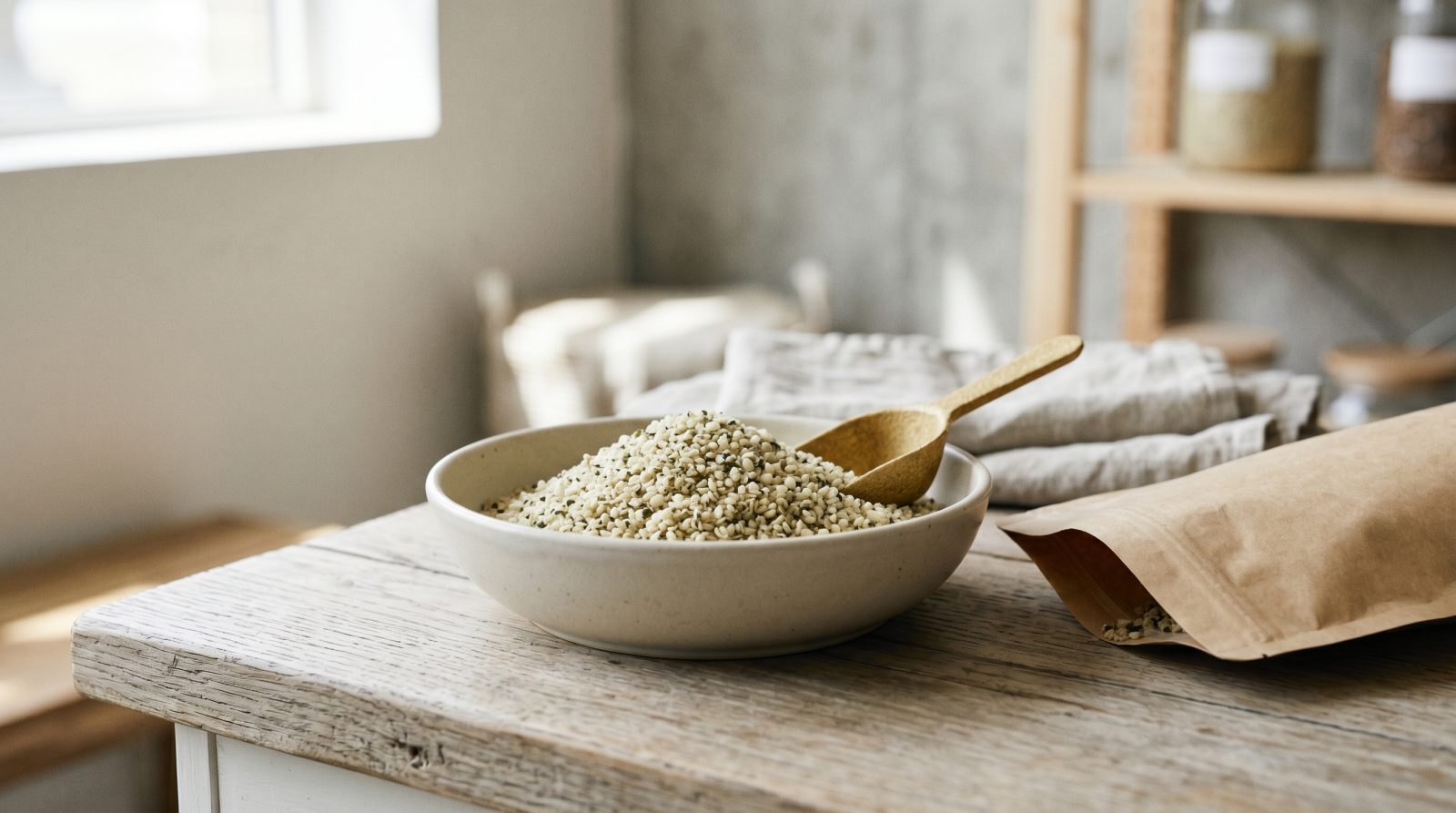
Buying shelled hemp seed well comes down to four factors: freshness, source, packaging, and price. Brand name matters less than these underlying attributes. Get those four right and the logo on the bag matters surprisingly little.
The four shopping factors
1. Best-before date
Shelled hemp seed's polyunsaturated fats degrade gradually. The clearest single indicator of freshness is how far the best-before date is from your purchase date. Target dates at least 6 months out. Dates within 60 days suggest the product has been in distribution for some time and may have lost quality even before opening.
2. Country of origin
Canadian-grown product is traceable to a licensed grower under Health Canada's Industrial Hemp Regulations. Most imported product comes from China, Romania, Ukraine, or France. None is inherently inferior, but Canadian-grown has shorter supply chains and clearer regulatory oversight. The country of origin should be on the package; if it is unclear, the brand's website or customer service can clarify.
3. Packaging integrity
Look for:
- Opaque or dark-tinted bags or jars (light protection)
- Resealable closure (slows oxidation after opening)
- Sealed inner barrier intact (no visible damage)
- Refrigerated storage at point of sale (premium quality signal)
4. Price per gram
Pricing in Canadian retail spans a wide range. Mid-2026 typical pricing:
| Format | Typical price (CAD) | Per kg cost |
|---|---|---|
| 250 g standard grocery | $7-12 | $28-48 |
| 500 g natural foods retail | $12-20 | $24-40 |
| 1 kg Costco Kirkland or equivalent | $18-25 | $18-25 |
| 2 kg+ bulk online | $30-45 | $15-25 |
| Premium organic 250 g | $15-22 | $60-88 |
| Regenerative Organic Certified 250 g | $18-28 | $72-112 |
Where to buy in Canada
- Standard grocery (Loblaws, Sobeys, Metro, Walmart, Save-On). Reliable selection of mainstream brands at moderate prices.
- Costco. Best price per gram for shoppers who can use bulk volume within 3 to 6 months refrigerated.
- Natural foods retailers (Whole Foods, Healthy Planet, Nature's Emporium). Wider brand selection including organic and Regenerative Organic Certified options.
- Online retailers (Amazon, brand direct websites). Convenience and access to specialty brands; check shipping speed to ensure freshness.
- Farmers' markets. Limited availability; some Prairie producers sell direct at regional markets.
When to buy organic
Canadian hemp acreage receives minimal pesticide application even without organic certification (most growers use few or no synthetic chemicals due to hemp's inherent pest resistance and limited registered pesticide options). The gap between organic and conventional is smaller than for many other crops.
Organic still adds verification of practices and exclusion of any synthetic inputs. Whether the premium (25 to 40 percent over conventional) is worth it depends on individual priorities. For shoppers prioritising regenerative practices specifically, Regenerative Organic Certified is a stronger signal.
Red flags
- Very long best-before dates (over 24 months) on shelled hemp seed: hemp is naturally perishable; very long dates suggest preservative use or unrealistic claims.
- No country of origin listed: unverified supply chain.
- Sharp, bitter, or fishy smell from a freshly opened package: rancidity, return for refund.
- Mould visible on individual kernels: discard the bag and return for refund.
- Unrealistic health claims on packaging ("cures inflammation", "treats anxiety"): regulatory violations and a sign of poor brand quality control.