
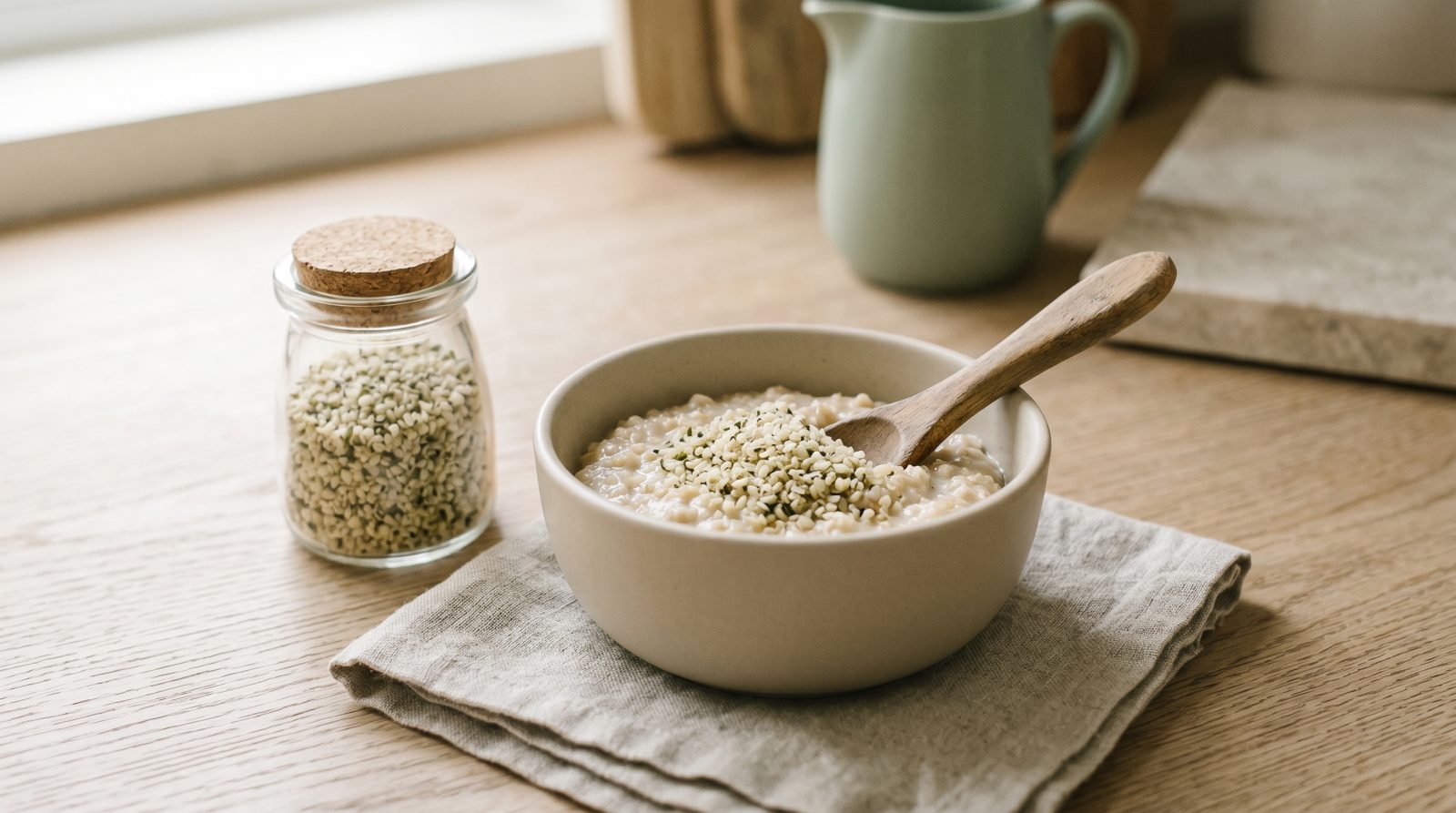
Babies can eat shelled hemp seed (hemp hearts) from about 6 months of age, when they start solid foods, as long as the hemp hearts are ground first and mixed into a food they already eat. Hemp is not one of Canada's priority food allergens, but allergic reactions to hemp seed have been reported, so offer a small amount the first time and watch your baby afterwards.
At what age can babies eat hemp seeds?
Babies can eat ground hemp hearts from about 6 months, the age at which Health Canada and the Canadian Paediatric Society recommend starting solid foods alongside breast milk or formula. Neither body sets a separate age for hemp. What matters at 6 months is the form: ground and mixed into food, not whole seeds (see preparation below).
Age is only part of readiness. The Canadian Paediatric Society describes a baby who is ready for solids as one who can sit up without support, shows interest in food, opens their mouth when food comes near, can pick up food and hold it in their mouth, and leans back or turns away when they have had enough.
Health Canada and the Canadian Paediatric Society recommend iron-rich first foods: meat, poultry, fish, cooked egg, tofu, well-cooked legumes and iron-fortified infant cereal. Hemp hearts work best as an add-in to those foods rather than a first food in their own right. At baby-sized amounts they supply very little iron (see the table below).
Are hemp seeds an allergen for babies?
Hemp seed is not one of Canada's priority food allergens, but it can cause allergic reactions. The medical literature on hemp seed allergy is small, made up mostly of case reports and case series, and it includes cases of anaphylaxis after eating hemp seed.
Health Canada's priority food allergens are eggs, milk, mustard, peanuts, crustaceans and molluscs, fish, sesame seeds, soy, sulphites, tree nuts, and wheat and triticale. Current Canadian advice to introduce allergenic foods early, at about 6 months (and not before 4 months for babies at high risk of allergy), is about common allergens such as peanut, egg, cow's milk, sesame, tree nuts, soy, wheat and fish. It does not address hemp, so there is no specific recommendation for or against offering hemp early.
In practice, treat hemp like any new food with a small but real allergy risk: introduce it on its own, in a small amount, and watch for a reaction (steps below). If your baby already has a diagnosed food allergy, especially to other seeds or nuts, ask your doctor or allergist before adding hemp. For symptoms and cross-reactivity in older children and adults, see this overview of hemp seed allergies.
How should hemp seeds be prepared for a baby?
For babies, grind hemp hearts (or blend them smooth) before mixing them into a moist food such as iron-fortified infant cereal, a purée or plain yogurt, and do not offer them whole. Health Canada lists seeds, along with nuts, popcorn and hard candy, among the foods that are not safe for children younger than four years, because hard, small and round foods can block a young child's airway. Hemp hearts are smaller and softer than most nuts and seeds, but the guidance makes no exception for them, and Alberta Health Services places whole seeds among the foods that cannot be made safer before age four.
- Grind them. A clean coffee or spice grinder turns hemp hearts into a soft meal in a few seconds. They are oily, so they turn pasty if ground too long. Grind only what you will use within a few days and keep it in the fridge.
- Stir them into moist food. Mix ground hemp hearts into apple sauce, mashed banana, vegetable purée, cooled oatmeal, iron-fortified infant cereal or plain whole-fat yogurt.
- Thin hemp seed butter; never serve it by the spoonful. Blend it with an equal amount of warm water and stir it into infant cereal or yogurt. Nut and seed butters can stick to the roof of a young child's mouth or in the throat, which is why Health Canada warns against serving peanut butter alone or on a spoon.
- Skip whole (in-shell) hemp seed. It still has its hard, crunchy hull. For babies, use shelled hemp seed (hemp hearts), ground.
- Leave out honey. If you sweeten hemp porridge or cereal, do not use honey before 12 months; Health Canada advises against it because of the risk of infant botulism.
Textures should progress as your baby grows. Health Canada recommends offering lumpy textures no later than 9 months and moving toward a variety of textures modified from family foods by one year. Once your baby starts to self-feed, ground hemp hearts can go into soft finger foods such as pancakes, muffins or bean patties.
How do you introduce hemp seeds to a baby?
Offer a small amount the first time, such as a pinch of ground hemp hearts mixed into a little of a food your baby already eats, offered on the tip of a spoon. Give it at home, at a time when your baby will be awake for the next two hours; this is how the Canadian Society of Allergy and Clinical Immunology and Food Allergy Canada advise introducing common allergens, and it suits any new food that carries some allergy risk.
- Introduce one new food at a time, so that if your baby reacts you know which food caused it.
- Allergy symptoms usually appear within minutes of eating, but can take up to two hours.
- Mild signs include a few hives. Redness around the mouth may simply be skin irritation from the food.
- Signs of a more severe reaction include swelling of the lips, eyes or face; vomiting; hives all over the body; repeated coughing, wheezing or any difficulty breathing; pale or blue skin colour; and sudden tiredness or limpness. Call 911 if you see these.
- If you think your baby has reacted, stop offering hemp and speak to your doctor.
If there is no reaction, give the rest of the serving at your baby's usual pace. Hemp can then become a regular part of your baby's meals.
How much hemp seed should a baby have?
About 1/2 to 1 teaspoon of ground hemp hearts a day, stirred into a meal, is a practical amount for a baby, and 1 to 2 teaspoons a day for a toddler; no Canadian guideline sets an amount, so keep it small and let your baby's appetite lead.
Health Canada recommends responsive feeding: the child decides how much to eat, guided by hunger and fullness cues. Hemp hearts are high in fat and calories (about 18 calories per teaspoon), which suits small appetites but means large amounts can crowd out the iron-rich foods babies need most.
Can toddlers eat hemp seeds?
Yes. Toddlers can eat hemp hearts in everyday foods, but because Health Canada's list of foods that are not safe before age four includes seeds, grind them first and mix them into moist or baked foods rather than offering them whole, as a dry handful or as a snack on their own.
- Ground hemp hearts stirred into yogurt, oatmeal or apple sauce
- Blended into smoothies
- Baked into pancakes, muffins or banana bread
- Mixed into hummus, bean dips, meatballs or patties
What a teaspoon of hemp hearts provides
| Nutrient | 1/2 tsp hemp hearts (about 1.7 g) | 1 tsp (about 3.3 g) | Daily reference, 7–12 months | Daily reference, 1–3 years |
|---|---|---|---|---|
| Protein | 0.5 g | 1.1 g | 11 g | 13 g |
| Omega-3 (ALA) | 0.14 g | 0.29 g | 0.5 g | 0.7 g |
| Magnesium | 12 mg | 23 mg | 75 mg | 80 mg |
| Iron | 0.13 mg | 0.27 mg | 11 mg | 7 mg |
| Zinc | 0.17 mg | 0.33 mg | 3 mg | 3 mg |
Hemp amounts are calculated from USDA FoodData Central values for hulled hemp seed, taking 3 tablespoons as 30 g (so 1 teaspoon is about 3.3 g); daily references are Health Canada's Dietary Reference Intakes for intake from all foods, including breast milk or formula. A teaspoon of hemp hearts covers roughly a third of the daily magnesium reference for a baby aged 7 to 12 months and more than half of the omega-3 reference, but less than 3 percent of the iron. Plant iron is absorbed better alongside vitamin C foods such as berries, tomatoes or peppers, but at these amounts hemp does not replace iron-rich first foods. For the full nutrient profile of a standard serving, see shelled hemp seed nutrition.
Other safety points
- THC. Shelled hemp seed is a food, not a cannabis product: Health Canada's 2025 regulatory analysis describes non-viable hemp seed and other exempted hemp parts as generally not containing significant levels of cannabinoids. Canada dropped its specific THC limit for hemp grain products (10 parts per million) in March 2025; they must meet the same Food and Drugs Act requirements as other foods.
- Hemp beverages. Hemp "milk" is not a substitute for breast milk or infant formula. Health Canada advises that soy, rice, almond and other plant-based beverages are not appropriate as the main milk for a child younger than two.
- Freshness. Hemp hearts are rich in polyunsaturated fat and can go rancid. If they smell bitter or stale, throw them out. See how to store shelled hemp seed so it stays fresh.
When to check with a doctor first
Talk to your doctor, nurse practitioner or a registered dietitian before adding hemp if your baby has a diagnosed food allergy, feeding or swallowing difficulties, a medically restricted diet, or concerns about growth. If you are unsure whether your baby is ready for solid foods at all, have that conversation before adding extras such as hemp.