
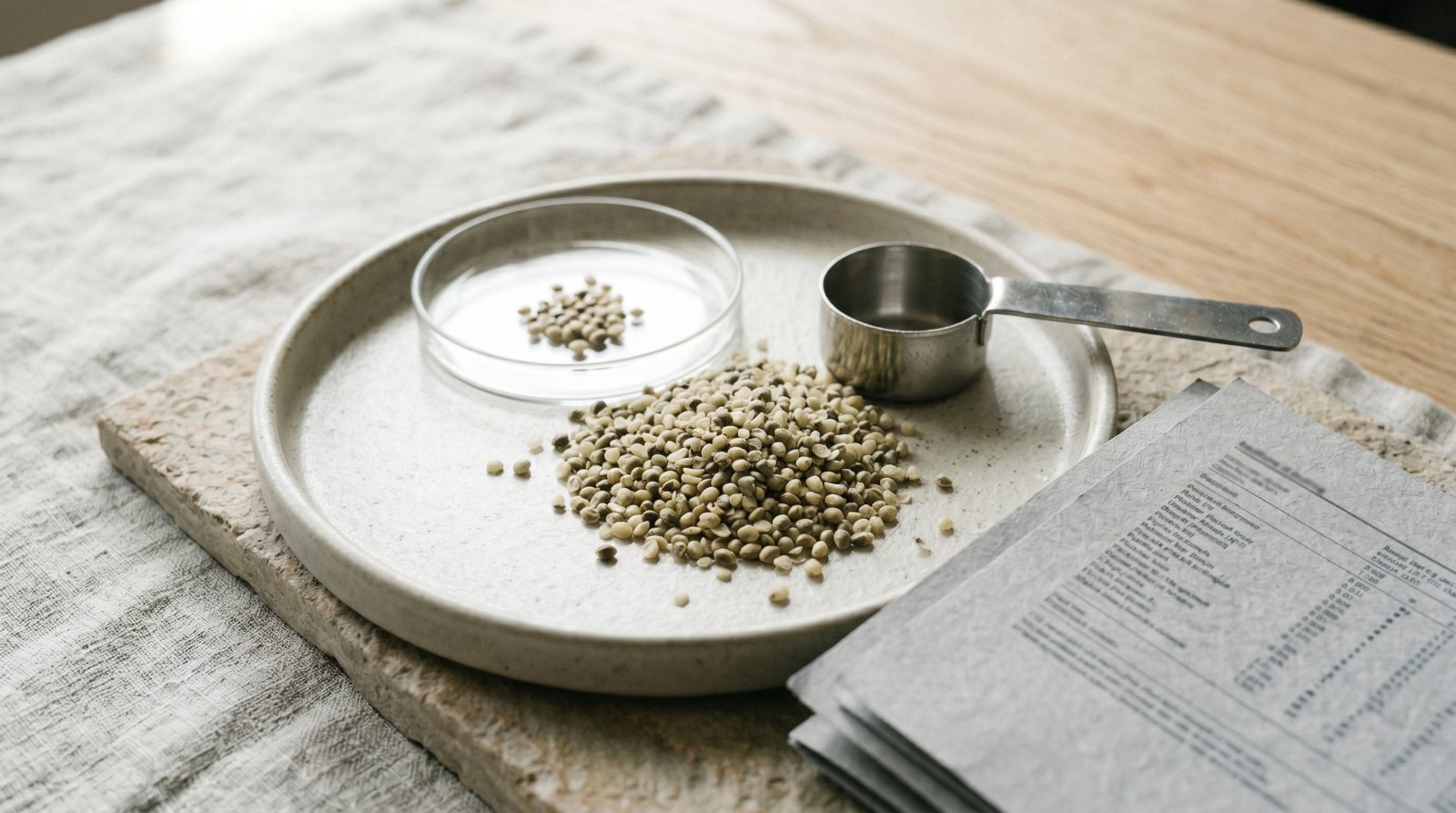
Shelled hemp seed is generally a safe and well-regulated food, but quality varies between brands and batches. Independent testing has found problems in some products: in a 2026 review of six organic hemp heart brands, ConsumerLab found two with mould well above the accepted spoilage limit. Understanding what quality testing involves helps shoppers interpret label claims and brand reputation.
What is tested for hemp seed quality
Mould and microbial contamination
Hemp seed is hygroscopic (absorbs moisture) and can support mould growth if stored improperly during cultivation, processing, or distribution. Standard microbiological testing includes:
- Total plate count (general bacterial load)
- Yeast and mould count
- E. coli (indicator of fecal contamination)
- Salmonella (pathogen testing)
- Specific mycotoxins (aflatoxins, ochratoxin A) if storage conditions raise concern
Heavy metals
Hemp plants are known to absorb metals from soil (a property used in phytoremediation). That makes a heavy metal panel worth looking for on a hemp seed COA. Standard testing includes:
- Lead (Pb)
- Cadmium (Cd)
- Arsenic (As)
- Mercury (Hg)
Health Canada sets maximum levels for some metals in specific foods, such as lead in fruit juice and inorganic arsenic in rice, but has no maximum level written specifically for hemp seed. When a COA reports metals, check which limit the results are being compared with. The 2026 review described below, for example, used California's Proposition 65 levels.
Pesticide residues
Pesticide residues in food sold in Canada must stay within the maximum residue limits set by Health Canada. Where no specific limit has been set for a pesticide on a given food, residues must not exceed 0.1 ppm. A pesticide screen on a COA shows that a batch has been checked.
Cannabinoid content
Hemp seed contains far less THC than the plant's flowers and leaves. The 0.3 percent THC limit that defines industrial hemp in Canada applies to the plant's flowering heads and leaves, not to the seed. On March 12, 2025, Health Canada removed the separate 10 ppm THC limit and the testing requirement for hemp seed derivatives (products made by processing the seed), so a THC result on a COA is now something a supplier chooses to provide or a buyer asks for, not a federal requirement.
Nutritional accuracy
Some brands verify that the nutrition facts on the label match analytical testing of the actual product (protein content, fat profile, mineral content).
ConsumerLab's 2026 hemp seed review
ConsumerLab, a US-based independent product-testing organisation, published a review of six organic hulled hemp seed (hemp heart) brands on May 7, 2026. The products were bought online or at retail, and were tested for mould and yeast, other microbial contamination, heavy metals, and whether nutrient levels matched the label. ConsumerLab's review summary and its May 13, 2026 press release reported:
- Two of the six products were not approved because they contained mould at roughly 3 and 9 times the accepted spoilage limit. The reviewers said this pointed to possible spoilage from poor storage or contamination during processing.
- No product was contaminated with E. coli, Staph, Salmonella, or Listeria.
- None exceeded safety limits for lead, arsenic, cadmium, or mercury, although the product with the highest mould count also had the most cadmium, about three times as much as any other product.
- All six contained their listed nutrients within a reasonable margin.
ConsumerLab's public pages do not report any THC or cannabinoid test results, and results for individual products are available only to paying members. ConsumerLab is based in the United States and does not say in which country the products were bought, so the results may not reflect what is on Canadian shelves. The review shows that quality can differ between products even in a well-regulated category, which is why freshness, storage, and batch testing matter.
What Certificate of Analysis (COA) documents
A Certificate of Analysis is a laboratory report verifying a specific batch's composition and safety. Reputable brands and bulk suppliers will provide a COA on request. A typical COA includes:
- Lot or batch identifier
- Test date and laboratory information
- Microbiological results
- Heavy metals results
- Pesticide screening results
- THC or other cannabinoid results, if the supplier tests for them
- Nutritional analysis
How to evaluate brand quality
- Will they provide a COA on request? The willingness to share batch testing data is a strong quality signal.
- What is the country of origin transparency? Canadian-grown product with traceable supply chain is generally more transparent than imported product with unclear sourcing.
- Are claims realistic? Bold health claims ("cures inflammation", "treats X") are a red flag. In Canada, claims that a food treats or cures a disease are tightly restricted under the Food and Drugs Act.
- How does the product smell on opening? Fresh hemp has a mild nutty aroma. Sharp, bitter, or fishy notes indicate rancidity.
- Is the brand active in industry organisations? Membership in the Canadian Hemp Trade Alliance or similar bodies indicates engagement with industry standards.