
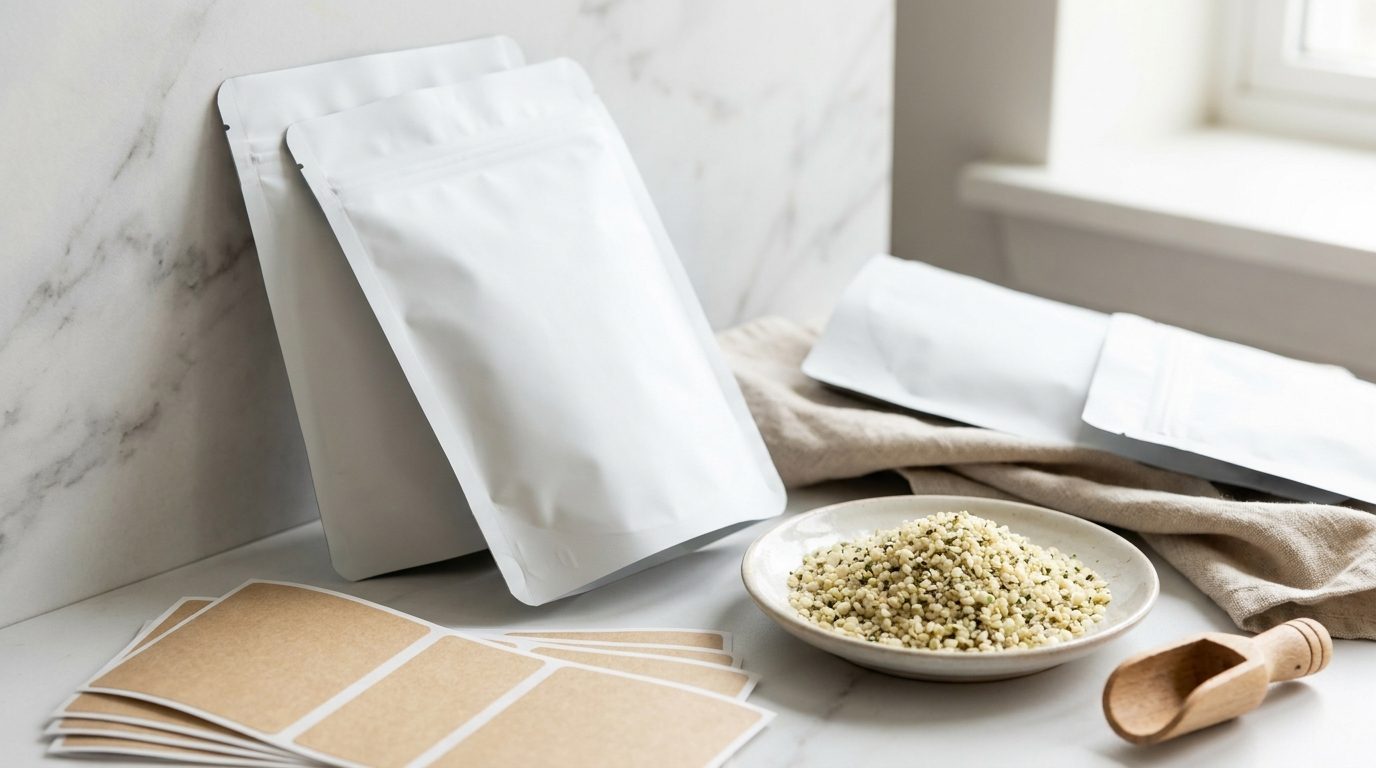
Putting your own brand on a bag of hemp hearts looks simple from the shelf, but the gap between buying a wholesale tote and owning a finished, retail-ready private-label product is where most new brands lose money and time. This is the end-to-end playbook for sourcing shelled hemp seed under your own label, covering the questions a generic wholesale guide never gets to.
What's the difference between wholesale, white-label, and private label?
These terms get used interchangeably, and the confusion costs people real money. They are not the same arrangement, and the one you choose dictates your margins, your minimums, and your legal exposure.
- Wholesale means you buy finished, already-branded product (or unbranded bulk) and resell it. You own no formulation and no packaging design. This is the fastest path but the thinnest margin and offers no brand differentiation.
- White-label means a huller produces a standard hemp hearts product and lets multiple customers slap their own label on the identical lot. The product behind your bag and your competitor's bag may be the same.
- Private label is the most involved: you specify the product (seed origin, particle size, packaging format, sometimes a custom blend or roast) and the co-packer produces it to your spec. You control more variables, but you also accept higher minimums and more responsibility.
For a single ingredient like shelled hemp seed, the practical reality is that most "private label" arrangements sit somewhere between true white-label and full custom. The seed itself is a commodity; your differentiation comes from sourcing story, packaging, particle consistency, and freshness handling rather than a secret recipe.
How do you find a huller willing to white-label?
Most hemp processors are set up to sell bulk totes to food manufacturers, not to run small branded packs. Finding one that will white-label takes targeting the right type of operation. Look for processors that already run a consumer-facing line, because they have the small-format packaging equipment and the food-safety paperwork a co-pack relationship requires.
When you reach out, the questions that quickly separate a real partner from a tire-kicker are these:
- Do you hull and pack in the same facility, or do you buy hulled seed and only pack? (Single-facility operations give you tighter traceability.)
- What food-safety certifications do you hold, and can you share an audit summary? Retailers and distributors will eventually ask, so confirm it up front.
- Will you run my packaging, or only your stock pouches with my label applied?
- What is your typical lead time from PO to finished pallet, and what's your reorder cadence?
Be candid about your expected volume on the first call. A processor's willingness to white-label is almost entirely a function of whether your order is worth a production changeover. Small, honest, repeatable orders often beat a large one-time order in their eyes because changeovers are the expensive part.
What MOQs should you expect?
Minimum order quantities are the single biggest reason first-time brands stall. There are really two minimums in play, and you must clear both:
- The processor's production minimum — the smallest batch they'll run on their line without losing money on the changeover. For shelled hemp seed this is typically measured in pallets or in hundreds of kilograms, not in cases.
- The packaging minimum — if you're printing custom pouches, the film printer has its own MOQ, often far larger than you'll use in your first production run. Printed roll-stock and pouches commonly come in quantities that represent many months of sales for a young brand.
The packaging MOQ frequently dwarfs the product MOQ, and it is where new brands get over-committed. A practical first move is to launch on a stock pouch with a printed pressure-sensitive label, which lets you order a small product run without committing to a film print run. You upgrade to custom-printed film once your velocity justifies it.
Custom pack or bulk tote — which should you order?
This decision hinges on where your operation actually adds value and where you'd rather not own risk.
| Consideration | Bulk tote (you pack) | Custom pack (co-packer packs) |
|---|---|---|
| Per-unit cost of seed | Lowest | Higher (you pay for their labour and line) |
| Your facility needs | Packing room, scales, sealing, pest control, food-safety plan | None beyond storage |
| Freshness control | You manage flushing and cold storage | Built into their process |
| Regulatory burden | You become a food packer with all that entails | Largely sits with the co-packer |
| Best for | Brands with existing packing infrastructure | Brands focused on marketing and distribution |
Shelled hemp seed is high in polyunsaturated fats, which means it is sensitive to oxidation, light, and heat. If you pack from a bulk tote without nitrogen flushing, proper barrier film, and cool storage, you risk rancidity complaints that no branding can fix. Unless you genuinely have food-grade packing capability, custom packing through the co-packer is usually the safer choice for a hemp hearts launch.
Who owns the lot COA?
This is the question the generic wholesale guides skip, and it's the one that protects you in a recall or a retailer dispute. A Certificate of Analysis documents what's actually in a specific production lot — microbial results, and for hemp specifically, confirmation that the seed itself does not carry a cannabinoid problem, plus often heavy metals and pesticide screening for food-grade lots.
Clarify these points in writing before your first PO:
- Will I receive a lot-specific COA tied to the exact code on my finished pouches? A generic "typical analysis" sheet is not the same as a COA for your lot, and a retailer's quality team will know the difference.
- Does the testing follow my finished lot, or only the inbound seed? Ideally the COA maps to the lot code printed on your retail unit.
- Who retains the retention samples, and for how long? If a complaint surfaces months later, someone needs a sealed sample to test.
- Can I use the COA data in my own marketing or to onboard a distributor? Some co-packers restrict this; get permission explicitly.
As the brand of record, you carry the liability that consumers see your name on. Even when the co-packer does the testing, build a routine of collecting and filing every lot COA yourself. If you ever change processors or face a quality question, that paper trail is the difference between a contained issue and a brand-damaging one.
Putting the deal together
Before you commit to a partner, ask for a paid sample run of a single small lot under your label so you can taste it, check the seal and barrier, run it past a few trusted customers, and confirm the COA arrives as promised. Negotiate your reorder pricing and lead times at the same time, because your real costs show up on the second and third orders, not the first. Lock down in writing who owns the artwork, who owns the formulation spec, and what happens to your unused custom packaging if you switch suppliers. Those clauses feel like overkill on day one and indispensable the day a relationship changes. For more sourcing and bulk-buying guides, browse the full articles index, then start your shortlist with two or three processors so you're never dependent on a single line.