
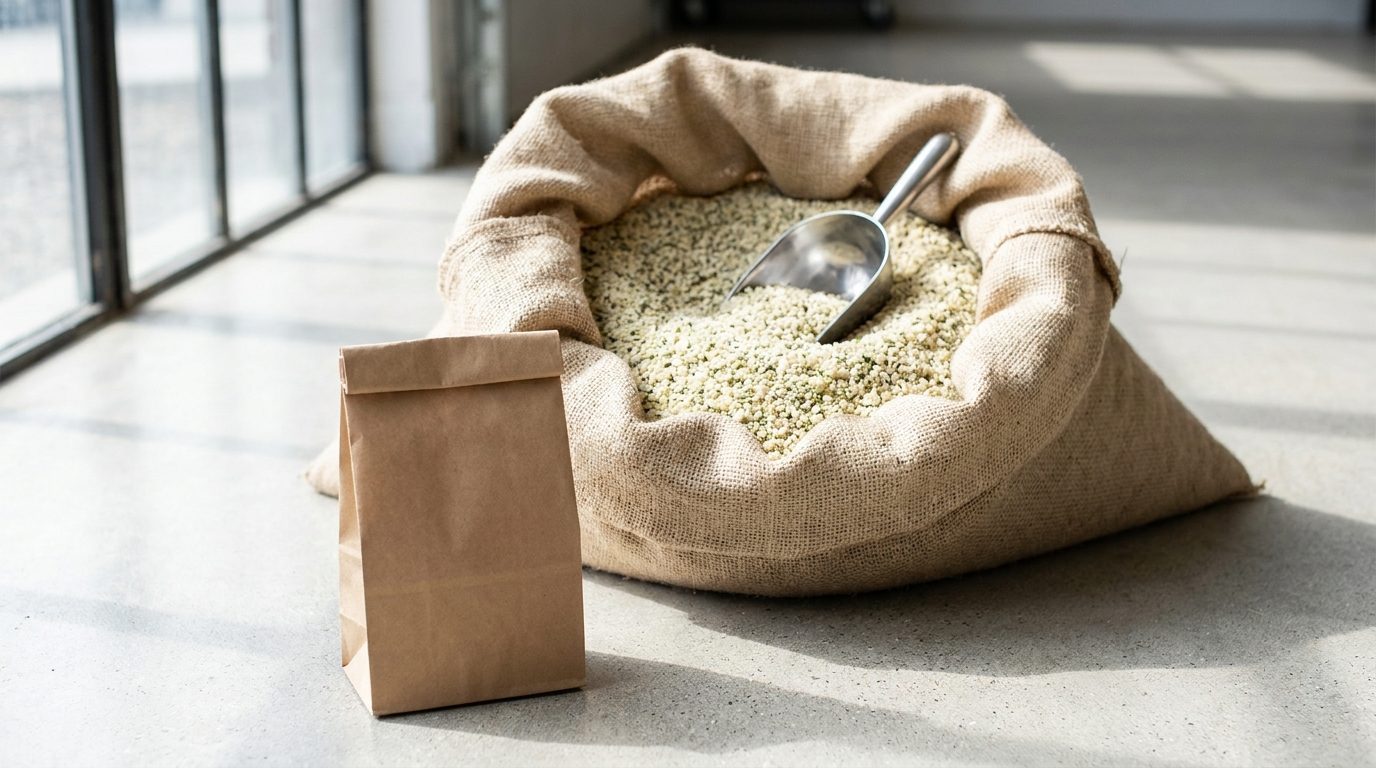
The first quote most new bulk buyers receive is not a price problem, it is a quantity problem. The per-kilo number looks fine; the minimum order quantity attached to it does not.
Why does one supplier want 25 kg and another want a full pallet?
A minimum order quantity is not a measure of how much the supplier likes you. It is a reflection of where that supplier sits in the chain and what physical form the seed is already in when your order arrives.
A processor who dehulls and packs in-house is handling seed in totes or large-format bags. To fill a 25 kg order they have to open a bulk container, decant, reseal, and account for the remainder. That handling has a fixed labour cost regardless of order size, which is exactly why small orders carry either a high MOQ or a small-order surcharge. A distributor who already stocks smaller cartons in a warehouse can break a pallet without touching the seed itself, so their MOQ is lower and their per-kilo price is higher. You are choosing between paying for flexibility and paying for scale.
Packaging format drives this more than anything. Common bulk formats cluster around a handful of sizes, and MOQs tend to snap to whole units of whichever format the supplier runs:
- Retail-adjacent cases of small pouches, sold by the case
- Foodservice-size bags in the 5 to 25 kg range, sold by the bag or by the case of bags
- Large-format bulk bags and totes, sold as single units and typically requiring freight rather than parcel shipping
If your requested quantity does not land on one of those boundaries, you will usually be quoted up to the next one.
What is actually negotiable in an MOQ?
More than most buyers assume, but rarely the headline number on its own. Suppliers protect MOQ because it protects their margin on handling. What they will often flex on instead:
- The trial order. Many suppliers carve out a one-time sample or trial quantity well below their standard MOQ, on the understanding that a repeat order meets it. Ask for this explicitly rather than asking them to lower the MOQ permanently.
- Blended orders. If the supplier also carries whole hemp seed, hemp protein powder or hemp seed oil, a mixed pallet that hits their total weight or value threshold may satisfy the minimum even when no single line item does.
- Scheduled release. Committing to a larger total volume drawn down in scheduled shipments over several months can get you MOQ-level pricing without warehousing it all at once. This works best with a supplier who has storage capacity and wants forecast visibility.
- Packaging format. Accepting the supplier's standard bag size instead of requesting a custom fill often removes the surcharge that was quietly baked into the small-quantity quote.
What is generally not negotiable is a minimum tied to a production run. If the supplier has to schedule dehulling time to fill your order, that run has a floor and no amount of goodwill moves it.
How should you size a first order you can actually sell through?
The temptation is to hit the MOQ that unlocks the best per-kilo price. Resist it until you know your turnover rate. Shelled hemp seed is high in polyunsaturated fatty acids and does not reward slow inventory. A pallet bought at an attractive price that sits for months in a warm warehouse becomes a quality problem long before it becomes a savings.
Work backwards instead. Estimate your monthly usage, decide how many months of stock you are prepared to hold given your storage conditions, and treat that as your ceiling. If the resulting quantity sits below the MOQ, the honest answer is that you are not yet a bulk buyer for that supplier, and a distributor with smaller break-bulk quantities is the better fit even at a higher unit price.
Does a higher MOQ mean a better product?
No, and it is worth saying plainly because the assumption is common. MOQ correlates with the supplier's position in the chain, not with seed quality. A processor with a high MOQ may be selling excellent, recently harvested seed, or may be clearing older stock at volume. A distributor with a low MOQ may be handling the same lot from the same processor.
Judge the seed on what the seed documentation says, not on how much of it you are being asked to buy. Ask for the lot's certificate of analysis, the harvest or production date, and the packing date, and ask whether the lot you would receive is the one the paperwork describes. A supplier who will not connect a specific lot to a specific document is a supplier to be careful with regardless of order size. Our other articles go deeper on reading those documents.
What does the MOQ conversation look like in practice?
Approach it as a supplier would. Lead with information they can use to price you accurately rather than with a request for an exception.
Tell them your realistic annual volume, your expected order frequency, your packaging preference, your destination for freight quoting, and whether you need any specific documentation. A supplier who can see a credible twelve-month picture has a reason to make the first order work. A buyer who opens with a question about the lowest quantity they will sell has given them nothing to work with and will get the standard answer.
Also ask what happens between orders. Does the price hold? Is the MOQ recalculated each time? Do they hold stock against a forecast? These answers matter more over a year than the first quote does.
Getting to a workable first order
Write down three numbers before you contact anyone: the quantity you can genuinely store in good conditions, the quantity you expect to use in ninety days, and the total you expect to buy in a year. Send the second and third to the supplier, buy no more than the first, and ask specifically about a trial quantity and a scheduled-release arrangement. If a supplier's standard MOQ still exceeds what you can turn over, buy from a distributor for two or three cycles, establish real usage data, and come back to the processor with a forecast rather than a request. That sequence gets most buyers to bulk pricing faster than negotiating hard on day one ever does.